
August 2026 · 8 min read
GLM 5.3 Flash: I Ran Zhipu's New MoE on Frontend Prompts
I ran GLM 5.3 Flash through OpenVibeEval the day it dropped. The 7 of 8 results put it in the GLM 5.2 band, not the GLM 5.3 ceiling, and the 0x Alpha kinship theory still holds up.
The scores in this article come from my own benchmark. The live results — every prompt, every rendered output — are on OpenVibeEval.
View the live benchmark Live benchmark
GLM 5.3 Flash frontend benchmark results
Z AI released GLM 5.3 Flash on August 26, 2026. I ran it through OpenVibeEval that day on the zcode and cline harnesses. Seven of the eight standard prompts went through cleanly. The crypto trading terminal run failed at JSON parse time, so I am holding that one back until I can rerun it.
Across the seven completed prompts, Flash averaged 73.1 on accessibility and 95.6 on performance. The performance number confirms the code loads and renders fast. The accessibility number is the one to watch.
In context across the GLM line, 73.1 sits between GLM 5.2 (72.3 in my tree) and the GLM 5.3 ceiling (88.1). Flash is not in the same tier as the max model. It is in the Flash tier, which is exactly what the name promises.
On the Artificial Analysis side, Flash scores 57.5 on the intelligence index and 71.5 on the coding index. Those numbers line up with what I saw on the frontend prompts. The model is built for high-volume, narrow tasks, not for the deep reasoning benchmarks.[1]
The MoE layout is the reason the cost comes down without losing the family resemblance.
Architecture and operational economics of Zhipu's MoE
Z AI built Flash as a Mixture of Experts. 320 billion total parameters, but only 18 billion active on any single forward pass. Sparse routing keeps memory bandwidth in check while the model still carries the broad capacity of the wider GLM family.[2][4]
The team reduced depth versus GLM 4.5. The official developer docs describe a hybrid attention setup for the 1 million token context window: linear attention for local state, sparse attention for long-range retrieval, and an IndexPool module that compresses key vectors with weighted pooling. I have not audited the math myself; I am reporting what the docs claim.[2]
API pricing is $0.15 per million input tokens and $0.50 per million output tokens. With a typical context caching ratio, the effective blended rate lands around $0.24 per million tokens.[1]
GLM 5.3 (max) lists at $2.15 per million blended. That is roughly a 9x cost drop on Flash. CI scripts, automated UI generators, and developer CLIs are the workflows that immediately benefit. Anything that loops over a lot of small generation jobs.
High speed and low cost only provide value if the output code retains visual and accessibility compliance.
High-ceiling execution on self-contained UI components
On isolated components Flash is precise. Single-page layouts, narrow scope, no cross-view state. The model produces valid HTML, clean CSS, and binds event listeners without runtime errors.
Four of the seven prompts landed in the 90 to 100 range on accessibility. Digital garden, retro arcade, web audio sequencer, and the CodeSense SaaS landing all rendered cleanly with strong contrast and proper focus indicators.
The pattern is clear: simple component generation, marketing hero sections, standalone audio tools, and grid-based content feeds are where Flash is reliable.
The single-file outputs use scoped CSS, bind event handlers correctly, and keep keyboard focus visible across the primary navigation. High scores on those prompts mean the model knows web layout fundamentals.
Performance shifts dramatically when the prompt requires intricate component interactions or multi-layered dashboard layouts.
The floor collapse on dense and interactive prompts
Prompt complexity is where Flash breaks. The moment a prompt needs dense interfaces with dynamic state, the accessibility score drops hard and the DOM tree starts losing structural integrity.
On the analytics dashboard prompt, Flash collapsed to an accessibility score of 10 points out of 100. The smartwatch storytelling prompt produced a score of 50 points. The vector drawing canvas prompt reached 66 points.
The analytics dashboard output is the worst case. The model dropped every form input label, broke keyboard tab order inside an interactive chart container, and nested invalid button tags inside clickable card containers. The page looked fine in a screenshot. axe-core flagged it as unusable.
A model that hits 10 accessibility on a complex dashboard is not safe to wire into a user-facing product without a validation gate at the boundary. The cost savings are real, but they evaporate the first time the output ships a component a screen reader cannot operate.
This volatile performance pattern offers critical data points when testing claims about earlier mystery models.
Revisiting the 0x Alpha kinship hypothesis
When 0x Alpha appeared on public leaderboards, developers guessed it was an unreleased Z AI checkpoint. I wrote about that in the 0x Alpha vs GLM 5.3 article and called the kinship likely. With Flash in hand I can revisit the question on identical OpenVibeEval prompts.
The data supports the kinship without proving identity. 0x Alpha averaged 77.3 accessibility across three harnesses. Flash averages 73.1 across two. Both models live in the same general capability tier.
Per prompt the alignment is striking. Both models score near-perfect on digital garden, retro arcade, and the web audio sequencer. They diverge on the analytics dashboard: Flash drops to 10, while 0x Alpha sits between 18 and 57 depending on the harness.
The cleanest summary: Flash looks like a cousin of 0x Alpha, not a clone. The shared structural quirks line up with the broader GLM 5.3 family, but individual fine-tuning checkpoints behave differently on complex UI layouts.
Harness choice and system prompt design still shape how those underlying characteristics play out in production.
Harness configuration and API integration parameters
Running Flash through zcode and cline is a useful reminder that the harness is not a passive wrapper. Context formatting, token limits, and code output consistency all change with the harness choice.
The official developer documentation covers the Flash API surface, including the model variant identifiers and the parameters the Z AI platform accepts. I am not going to repeat every detail here. Read the docs before wiring it into a production pipeline.[2][3]
curl https://api.cloudflare.com/client/v4/accounts/$ACCOUNT_ID/ai/run/@cf/zai-org/glm-5.3-flash -X POST -H "Authorization: Bearer $CLOUDFLARE_AUTH_TOKEN" -H "Content-Type: application/json" -d '{"messages": [{"role": "system", "content": "You are a specialized frontend generation engine."}, {"role": "user", "content": "Generate a single-file web audio sequencer in index.html."}]}'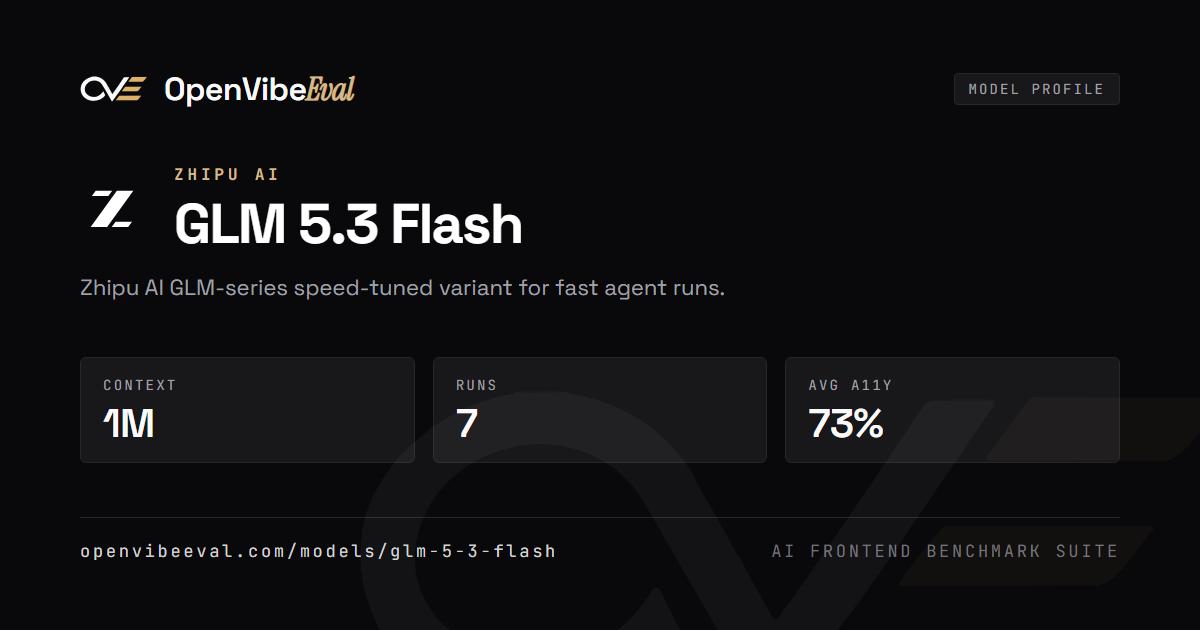
The Z AI and Cloudflare API endpoints support server-sent streaming events and external tool calls, and the responses follow JSON schema definitions. When configuring a coding harness, budget enough max output tokens that the model can finish CSS styling and JavaScript event binding in a single pass.[2][3]
Insufficient output token buffers are the most common cause of incomplete DOM trees in my runs. Set the context and max-output limits so the model can deliver a clean single-file structure on the first pass.
Understanding these technical integration requirements helps prevent subtle generation failures during automated component runs.
Accessibility auditing and DOM degradation patterns
Frontend evaluation has to look past the screenshot. Models render clean visual layouts and still hide severe accessibility defects underneath. Automated DOM auditing is the only way to surface them.
The gap between the performance and accessibility numbers on Flash is the cleanest example. Average performance 95.6, average accessibility 73.1. The code loads fast and parses cleanly. The DOM is missing ARIA attributes, and the HTML nesting is wrong in places.
The recurring failures I see: unlabeled input controls, non-interactive container elements handling click events, custom dropdown components built out of plain div tags, and custom CSS removing the default focus outline. Each one locks a real user out of the interface.
Wire automated accessibility checks into the generation pipeline. axe-core catches DOM violations immediately. Catching structural flaws in CI prevents non-compliant components from reaching production.
Implementing a clear deployment framework ensures development teams maximize the cost efficiency of Flash while preserving accessibility standards.
Production evaluation checklist for GLM 5.3 Flash
These notes are based on the standard OpenVibeEval prompt set, nothing proprietary. The recommendations are the specific steps I would take to wire GLM 5.3 Flash into a production coding workflow without shipping a regression.
First, add automated accessibility linting to the build pipeline. Run axe-core on every generated HTML file before merge. Reject any pull request that drops below an 80 accessibility score on a known prompt.
Second, route by complexity. High-volume component generation and basic landing pages are the right place to use Flash and pick up the $0.24 blended token cost. Dense analytics dashboards and multi-view applications belong on GLM 5.3 or a primary frontier model.
Third, configure the API request to leave enough headroom on max output tokens. 8,000 is the floor I would set so the model can finish HTML and JavaScript blocks without truncating the final pass.
Fourth, watch per-prompt token usage and effective cost in real time. The blended rate should sit near $0.24 per million across the developer harnesses you actually use. If it drifts, something is wrong with caching or with the request shape.
Sources
Related articles
Is 0x Alpha Just GLM 5.3? I Compared Them on Identical Prompts
Community speculation points to 0x Alpha being a repackaged GLM 5.3. I ran both through my frontend benchmark to verify if the kinship holds up.
0x Alpha: I Benchmarked the Stealth Model Beating Every Leaderboard
A mystery model dominates social media leaderboards. I ran it through my public frontend benchmark to see if it actually works for developers.
Leaderboards Do Not Render: Comparing AI Models for Frontend Work Fairly
Ignore aggregate leaderboard scores. For frontend generation, fair comparison requires identical prompts, manual rendering, and total transparency about your harness.
Same Model, Different Results: Why Your AI Coding Harness Matters
Model benchmarks are misleading. If you want better frontend output, stop worrying about the model and start auditing the harness that wires it to your files.