
September 2026 · 7 min read
Claude Fable 5.1: First Benchmarks After the Cache Price Cut
Anthropic released Claude Fable 5.1 with identical $10 and $50 base rates alongside a 75 percent cache read price cut. Here is the first OpenVibeEval data.
The scores in this article come from my own benchmark. The live results — every prompt, every rendered output — are on OpenVibeEval.
View the live benchmark Live benchmark
Claude Fable 5.1 delivers frontend execution with cheaper cache reads
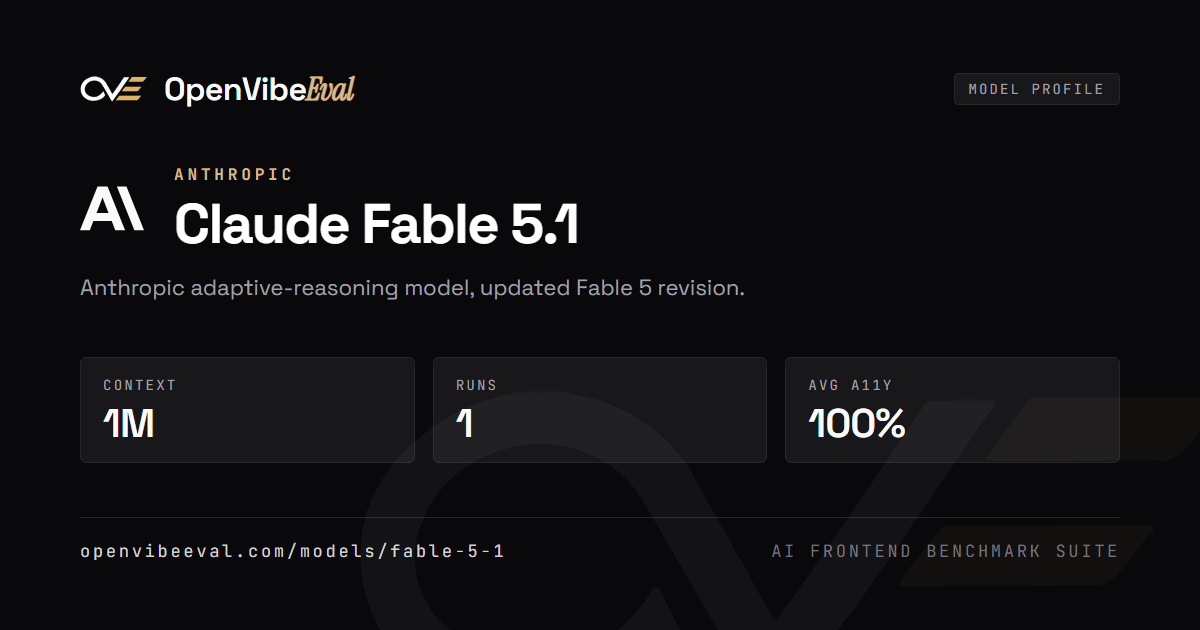
Anthropic released Claude Fable 5.1 on September 1, 2026, alongside Claude Mythos 5.1 for restricted cybersecurity applications. The headline platform update is not a standard price hike or a raw parameter expansion. Base input and output token rates remain at $10 and $50 per million tokens. Cache read pricing drops by 75 percent down to $0.25 per million tokens, paired with a 1 million token context window and a 128K token maximum output ceiling.[2][3]
On my first benchmark run using the OpenVibeEval frontend harness on September 2, 2026, Claude Fable 5.1 achieved an accessibility score of 100 with zero automated audit violations. It resolved the exact edge-case defects that its predecessor left open. The generated code delivered clean layout execution, stable interactive state management, and valid markup hierarchy.
Long-context agentic pipelines pay heavily for iterative cycles. When a harness inspects local files, formats system rules, and iterates on single-file code artifacts, prompt caching absorbs the repetitive token burden. Lowering cache read costs to a quarter of their previous rate transforms the operational economics of running a frontier reasoning model for continuous UI code generation.[2][3]
The baseline: why Fable 5 set the floor for UI generation
To evaluate what Fable 5.1 changes, you have to look at the baseline established by Claude Fable 5. On August 17, 2026, I ran Fable 5 through the official claude-code harness across all eight standard prompts in OpenVibeEval. The aggregate result was an average accessibility score of 98.1 out of 100 on the public benchmark.
The consistency of Fable 5 was unique across my entire evaluation dataset. Its lowest score across the suite was a 95 on the analytics dashboard, the crypto trading terminal, and the vector drawing canvas. It scored a perfect 100 on the SaaS landing page, digital garden, retro arcade, smartwatch storytelling, and web audio sequencer prompts. No other model family demonstrated such a reliable floor.[1]
Cheaper models frequently suffer from severe floor collapse on dense, interactive interfaces. GLM 5.3 Flash dropped to 10 on the analytics dashboard prompt in my testing. HY4 preview dropped to 0 on the high-density crypto trading terminal. Fable 5 never collapsed under layout complexity. It maintained structural integrity across every prompt type and produced compact implementations between 837 and 1,770 total lines of code.
First test run: patching the smartwatch storytelling flaws
The initial Fable 5.1 test evaluated the scroll-driven smartwatch storytelling prompt using the identical claude-code harness configuration. Running the new weights through the exact same environment ensures this single-prompt comparison isolates the model performance without introducing harness noise, differing system prompts, or variable tool execution patterns.
Fable 5.1 scored 100 on accessibility with zero axe-core violations, matching the accessibility ceiling of Fable 5 while fixing its two secondary regressions. On that prompt, Fable 5 shipped with a performance score of 85 and failed responsive viewport verification. Fable 5.1 achieved a performance score of 100 and validated full responsive support across mobile and desktop viewports.[1]
The updated output grew moderately in structural density. Fable 5.1 generated 984 lines of code and 356 DOM nodes, compared to 837 lines and 218 nodes produced by Fable 5 on the same prompt. The additional elements were purposeful additions. The model generated explicit media queries, added container queries for responsive element scaling, and structured custom animation timelines that render cleanly across different viewport dimensions.
The single prompt caveat: what we know and what is still queued
Honest benchmark reporting requires clarity about sample size. A single completed prompt out of an eight-part suite is an early indicator, not an aggregate verdict. I will not project a full benchmark aggregate score from one test run, and engineering teams should not assume the entire suite is settled based on a single successful execution.
Fable 5 represents the flattest quality distribution I have measured across any frontier model family. The first Fable 5.1 data point demonstrates that the model holds its ceiling on the specific prompt where Fable 5 left minor soft spots. The remaining seven evaluation runs are currently queued in the test pipeline, and the public model page will update as those results finish processing.
I have not tested Fable 5.1 on alternative third-party coding harnesses yet. There are also no blind-vote arena duels recorded on the model page at this time. Making up production case studies, user numbers, or commercial impact for a model that launched yesterday would be irresponsible. The data currently confirms one clean, improved run on one demanding prompt.
The economics of a 75 percent cache read price cut
The primary financial barrier to using frontier models in continuous development pipelines has always been the compounding cost of prompt history. Anthropic restructured that dynamic by pricing cache reads on Fable 5.1 at 0.025 times the base input rate. This marks a sharp drop from the standard 0.1 ratio applied to other Claude models in the catalog.[3][5]
Under the new rate structure, base input remains at $10 per million tokens and base output remains at $50 per million tokens. Five-minute cache writes cost $12.50 per million tokens, while one-hour cache writes cost $20 per million tokens. Cache reads drop from $1.00 down to $0.25 per million tokens. This $0.25 pricing applies directly across the Claude API, Amazon Bedrock, Google Cloud, and Microsoft Foundry.[3][5]
In a frontend generation workflow, the system prompt, component library schemas, and styling guidelines remain static across dozens of sequential turns. When an agent executes multiple inspection steps to locate a layout bug, it reads that pinned context repeatedly. Cutting cache read prices to a quarter of their previous level allows autonomous harnesses to retain deep context history without inflating session operational costs.[2][5]
Frontier reasoning versus verbosity: the per-task cost paradox
Cheaper unit prices for cached tokens do not automatically ensure every generation task becomes less expensive overall. Independent evaluation by Artificial Analysis on their Intelligence Index found that Claude Fable 5.1 at maximum effort cost $3.76 per evaluation task. This represents a 20 percent cost increase over Claude Fable 5, which cost $3.14 per task on identical workloads.[4]
This cost divergence occurs because Fable 5.1 generates approximately 1.7 times more output tokens than Fable 5 during complex reasoning tasks. Output tokens carry a steep price of $50 per million. The $0.75 discount on cached input reads saved approximately $1.40 per evaluation task on the Intelligence Index. Without that cache read price reduction, Fable 5.1 would have reached an estimated $5.16 per task.[4]
Engineering teams adopting Fable 5.1 must calculate their blended token expenses with precision. If an autonomous harness triggers extensive internal reasoning cycles and emits verbose component code, higher output volume can counterbalance prompt cache savings. Fable 5.1 is built for high-difficulty tasks where semantic correctness outweighs minimal token consumption.[2][4]
Configuring the API call for prompt caching
To capture the $0.25 cache read price, your API requests must explicitly declare cache control breakpoints on large prompt blocks. Anthropic requires a minimum prompt length of 512 tokens to create a cacheable prefix. Any request prefix below that threshold runs at the standard $10 base input rate.[3][5]
Developers structuring multi-turn agent harnesses should pin shared context blocks early in the payload array. This includes system prompts, design system tokens, framework definitions, and file trees. By applying the ephemeral cache control attribute to these large static blocks, subsequent turns avoid full token reprocessing fees.[3][5]
{
  "model": "claude-fable-5-1",
  "max_tokens": 8192,
  "messages": [
    {
      "role": "user",
      "content": [
        {
          "type": "text",
          "text": "/* Pinned design system rules and full CSS component definitions */",
          "cache_control": { "type": "ephemeral" }
        },
        {
          "type": "text",
          "text": "Build a scroll-driven smartwatch storytelling interface in a single index.html file."
        }
      ]
    }
  ]
}
Placing the cache control marker on your primary design system guidelines ensures that follow-up modification turns read existing state from memory. You pay $12.50 per million tokens for the initial five-minute write pass. Every subsequent agent turn that re-reads the pinned styling rules pays only $0.25 per million tokens, cutting the cost of multi-turn UI iteration.[3][5]
Evaluation checklist for testing Fable 5.1 in coding harnesses
Follow this practical sequence to evaluate Claude Fable 5.1 against your existing frontend generation workflows before updating production defaults.
Verify that your API client sets explicit cache control breakpoints on your shared system prompts. Confirm that your static prompt block exceeds the 512-token minimum requirement so your requests qualify for the $0.25 per million cache read rate.[3][5]
Run your generation harness on complex interactive components rather than simple marketing cards. Check whether the output generates valid accessibility attributes with zero audit errors. Verify that all interactive controls use native semantic markup. Confirm that the stylesheet includes responsive media queries for mobile viewports.[3]
Audit total output token volume across multi-turn sessions. Calculate your effective task cost to ensure that increased model reasoning length remains within your operational budget.[4]
Check the OpenVibeEval public dashboard as the remaining seven prompt results finish processing to compare cross-prompt consistency against the Fable 5 baseline.
Sources
Related articles
HY4 Preview Benchmarked: How the 770B MoE Compares
Tencent released HY4 preview as a 770B / 49B active MoE with 1M context, open-weights. I ran it through OpenVibeEval the same day. The model is bigger and reviewers like the intelligence story, but my accessibility numbers regressed. Here is the data.
GLM 5.3 Flash: I Ran Zhipu's New MoE on Frontend Prompts
I ran GLM 5.3 Flash through OpenVibeEval the day it dropped. The 7 of 8 results put it in the GLM 5.2 band, not the GLM 5.3 ceiling, and the 0x Alpha kinship theory still holds up.
0x Alpha: I Benchmarked the Stealth Model Beating Every Leaderboard
A mystery model dominates social media leaderboards. I ran it through my public frontend benchmark to see if it actually works for developers.
Leaderboards Do Not Render: Comparing AI Models for Frontend Work Fairly
Ignore aggregate leaderboard scores. For frontend generation, fair comparison requires identical prompts, manual rendering, and total transparency about your harness.
Same Model, Different Results: Why Your AI Coding Harness Matters
Model benchmarks are misleading. If you want better frontend output, stop worrying about the model and start auditing the harness that wires it to your files.