
September 2026 · 6 min read
Gemini 3.8 Flash Benchmarked: A 98 Ceiling and a 23 Floor
I evaluated Gemini 3.8 Flash on frontend prompts via antigravity-cli. It scores a 70.7 accessibility average, recovering from 3.7 while showing extreme variance.
The scores in this article come from my own benchmark. The live results — every prompt, every rendered output — are on OpenVibeEval.
View the live benchmark Live benchmark
Gemini 3.8 Flash benchmark results on OpenVibeEval
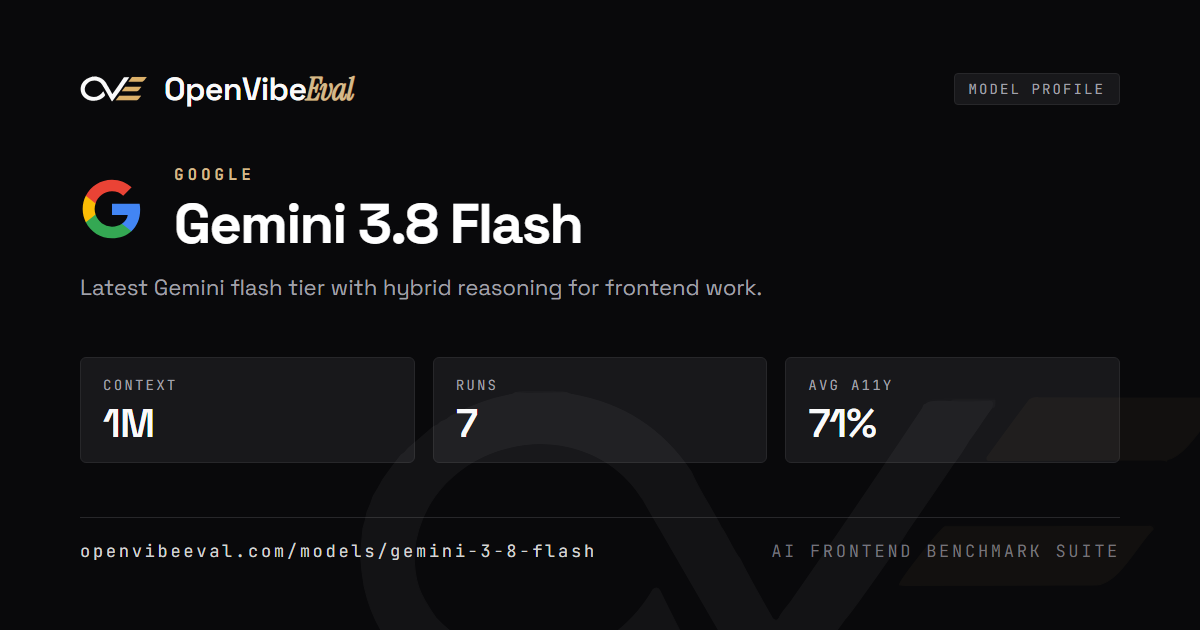
Gemini 3.8 Flash delivers a 70.7 average accessibility score across seven launch day prompts on OpenVibeEval, recovering substantial ground lost in the previous release. Google dropped this model on September 2, 2026, marking its fourth Flash iteration in less than four months and arriving twenty days after Gemini 3.7 Flash.[5]
I ran Gemini 3.8 Flash on launch day through my standard antigravity-cli harness. Seven of the eight standard OpenVibeEval prompts ran cleanly, while the smartwatch storytelling prompt remains pending. The raw artifacts and accessibility logs sit committed in the public OpenVibeEval repository.
On third-party tracks, Artificial Analysis scores Gemini 3.8 Flash high thinking at 59 on its composite Intelligence Index. That number places the model comfortably above the price-tier median score of 36.[2]
Composite intelligence indices aggregate diverse capabilities like mathematics, knowledge extraction, and multi-step reasoning. They do not capture how a model behaves when forced to generate structured HTML and interactive JavaScript under rigid single-file constraints. A respectable aggregate score of 70.7 masks an erratic spread across different frontend interface requirements.[2]
How 3.8 compares to 3.6 and 3.7 on the same harness
Generational comparisons only hold value when the execution environment remains fixed. The Gemini Flash lineage provides a rare harness-clean dataset because I ran 3.6 Flash, 3.7 Flash, and 3.8 Flash through the exact same antigravity-cli pipeline on identical prompt specifications.
The aggregate progression tells an instructive story of regression and partial repair. On the antigravity-cli harness, Gemini 3.6 Flash established an average accessibility baseline of 82.3 across all eight prompts. Gemini 3.7 Flash experienced a steep collapse down to an average of 37.9. Gemini 3.8 Flash rebounds to 70.7 across the seven prompts evaluated so far.
The per-prompt numbers show where version 3.8 repaired broken habits. On the crypto trading terminal prompt, version 3.6 scored 83, version 3.7 plunged to 8, and version 3.8 recovered slightly to 23. On the CodeSense SaaS landing page, version 3.6 scored 48, version 3.7 dropped to 23, and version 3.8 climbed back to 48.
Cross-family comparisons require methodological caution. My recorded aggregates for GLM 5.3 Flash at 73.1, HY4 preview at 70.4, and 0x Alpha at 77.3 were collected across zcode, Work-Buddy, and mixed execution wrappers. Those comparisons are directional rather than absolute. The internal 3.6 to 3.7 to 3.8 trajectory is harness-clean.
Google repaired the catastrophic bimodal failures that crippled Gemini 3.7 Flash on single-file layouts. Even with those repairs, version 3.8 Flash has not returned to the baseline accessibility consistency that 3.6 Flash originally established.
The 98 dashboard ceiling and the 23 crypto terminal floor
Gemini 3.8 Flash swings between top-tier execution and complete structural breakdown depending entirely on the prompt category. It generates outstanding code on structured dashboard layouts while failing fundamental accessibility checks on dense interactive tools.
The ceiling is higher than any previous Gemini generation on OpenVibeEval. On the analytics dashboard prompt, 3.8 Flash posted an accessibility score of 98 with a performance score of 100. It produced a clean digital garden layout at 96. The retro arcade game reached 93. The vector drawing canvas landed at 87.
The floor remains low enough to break production pipelines. On the crypto trading terminal prompt, the desktop layout scored 23 against a mobile score of 50, triggering four distinct axe-core violations. The web audio sequencer landed at 50, and the CodeSense SaaS landing page scored 48.
Dense state management triggers these failures. When a prompt requires concurrent real-time controls, streaming price tickers, or modular audio synthesis nodes, the model drops semantic labeling and mangles keyboard focus navigation.
A model that fluctuates from 98 down to 23 across tasks within a single test suite is not an unmonitored default for frontend engineering. You need strict boundary validation whenever generating dense interface patterns.
DOM degradation patterns in interactive prompts
Visual inspection of generated frontend code often masks severe underlying document structure defects. A generated component can render a clean modern aesthetic in a browser viewport while remaining completely broken under automated DOM analysis.
On the crypto trading terminal prompt, the failure stems from custom interface widgets replacing standard HTML elements. The model built order entry forms using unlabelled input containers, bound click listeners to generic division elements, and stripped keyboard focus rings with reset stylesheets. It generated four separate axe-core rule violations on the desktop viewport.
The web audio sequencer suffered from similar structural decay. It rendered synthesizer controls using custom drag sliders that lacked proper ARIA attributes, missing role definitions, value minimums, and value state updates entirely. The synthesizer functioned visually when clicked with a mouse, but screen readers and keyboard navigation could not interact with the controls.
Conversely, the analytics dashboard succeeded because its data visualization cards relied on native semantic containers. The model generated clean section wrappers, descriptive table headers, and proper label associations for filter controls, driving its 98 accessibility score.
These recurring degradation patterns show that Gemini 3.8 Flash handles static informational hierarchy exceptionally well. Its document structure collapses when forced to invent custom interactive widgets without native HTML equivalents.
Output verbosity and latency trade-offs
Gemini 3.8 Flash is the most verbose generation Google has shipped in the Flash family. It routinely outputs expansive code blocks that demand larger completion buffers in your execution harness configuration.
In my benchmark runs, version 3.8 Flash generated single-file artifacts ranging from 1,833 to 3,061 lines of code, averaging roughly 2,300 lines per output. Gemini 3.6 Flash typically hovered between 1,200 and 1,600 lines on the exact same prompt suite.
Independent telemetry shows rapid token generation paired with a noticeable initial wait. Artificial Analysis records an output throughput of 304.6 tokens per second against a price-tier median of 70.8 tokens per second. Time to first token averages 13.39 seconds, compared to the price-tier median of 3.02 seconds.[2]
You can inspect generation volume directly by checking output line lengths across your local harness runs.
wc -l ./output/gemini-3-8-flash/*.htmlThe combination of high token velocity and heavy verbosity produces complete files quickly once generation begins. However, the thirteen second time to first token makes it sluggish for interactive developer tooling that requires immediate feedback.[2]
The promotional pricing window before rates double
Google continues its established pattern of launching Flash tier models under aggressive introductory pricing windows before doubling rates for standard production usage.[3]
Gemini 3.8 Flash launched with API pricing set at $0.75 per million input tokens and $3.75 per million output tokens, supporting a one-million token context window. Prompt caching provides an additional ninety percent discount on cached input tokens.[2]
This introductory pricing expires on December 31, 2026. On January 1, 2027, pricing doubles to $1.50 per million input tokens and $7.50 per million output tokens according to Google's schedule.[3]
High output verbosity directly alters the operational cost equation. When an average UI generation pass consumes 2,300 lines of structured code, your output token burn increases significantly. Running high-volume batch generations during the introductory window yields substantial cost savings compared to the mandatory January rates.[2][3]
Teams planning high-throughput generation workflows must account for this scheduled pricing reset when modeling operational budgets for early 2027.[3]
A production evaluation checklist for frontend generation
Before wiring Gemini 3.8 Flash into an automated coding pipeline or UI component generator, establish protective boundaries against its prompt-type floor regressions.
Deploy this validation checklist in your build configuration:
- Gate all generated HTML with an automated axe-core accessibility audit before merge or deploy.
- Reject any single-file output that drops below an accessibility threshold of 75 on interactive components.
- Route static marketing pages, digital gardens, and analytics dashboards to Gemini 3.8 Flash to capture high-ceiling performance.
- Route dense real-time tools, audio sequencers, and complex trading grids to frontier models or specialized agents.
- Configure API completion buffers to at least 8,192 max output tokens to prevent truncated code on verbose generations.
- Audit input and output token consumption before the December 31, 2026 pricing transition doubles your API costs.[3]
Sources
- https://blog.google/innovation-and-ai/models-and-research/gemini-models/3-8-flash-and-3-8-flash-cyber/
- https://artificialanalysis.ai/models/gemini-3-8-flash
- Introducing Gemini 3.7 Flash
- [PDF] Gemini 3.8 Flash - Model evaluation - Google DeepMind
- Gemini 3.8 Flash: Release Intelligence, Performance & Price
Related articles
HY4 Preview Benchmarked: How the 770B MoE Compares
Tencent released HY4 preview as a 770B / 49B active MoE with 1M context, open-weights. I ran it through OpenVibeEval the same day. The model is bigger and reviewers like the intelligence story, but my accessibility numbers regressed. Here is the data.
GLM 5.3 Flash: I Ran Zhipu's New MoE on Frontend Prompts
I ran GLM 5.3 Flash through OpenVibeEval the day it dropped. The 7 of 8 results put it in the GLM 5.2 band, not the GLM 5.3 ceiling, and the 0x Alpha kinship theory still holds up.
Gemini 3.7 Flash Is Coding-Optimized: My Frontend Benchmark Says Check the Prompt Type
Gemini 3.7 Flash claims optimization for coding, but my frontend benchmarks show a stark, bimodal performance split that demands caution.
Leaderboards Do Not Render: Comparing AI Models for Frontend Work Fairly
Ignore aggregate leaderboard scores. For frontend generation, fair comparison requires identical prompts, manual rendering, and total transparency about your harness.
Same Model, Different Results: Why Your AI Coding Harness Matters
Model benchmarks are misleading. If you want better frontend output, stop worrying about the model and start auditing the harness that wires it to your files.