
August 2026 · 5 min read
When an AI Blog Pipeline Is Smarter Than a Prompt: Building a Grounded Generation System
I stopped treating LLMs like open-ended chatbots and built a deterministic pipeline. Here is how structured stages, deduplication, and human gates produce reliable technical content.
Why the Pipeline Matters More Than the Model
Building this automated drafting system taught me that content generation fails at the architecture level rather than the model level. When developers treat a large language model like an autonomous author, they usually pass a giant prompt and hope for the best. That single-prompt approach produces generic, unverifiable slop. The output sounds superficially competent while containing factual holes and vague generalities.
Reliability comes from systems engineering rather than model fine-tuning. Production content generation is an integration challenge involving data flow, API orchestration, and structured validation. You cannot fix architectural ambiguity with a clever system prompt. A stable pipeline enforces specific constraints at every boundary, guaranteeing that each phase produces verifiable data before downstream processing begins.[5]
I treat this pipeline like a traditional software compiler. Every stage consumes a validated input schema and emits a strictly typed artifact. If a model step produces invalid structure or misses required references, the step fails immediately. Treating natural language generation as a deterministic data pipeline removes guesswork from the entire publishing workflow.[3]
Grounded Architecture Over Autonomous Agent Loops
The industry often promotes open-ended agent loops that wander through tools without supervision. In practice, unconstrained autonomous loops drift from the original intent, accumulate hallucinations, and waste API tokens. A pipeline with defined, linear stages makes the entire drafting process auditable. You know exactly which transformation caused a failure.[5]
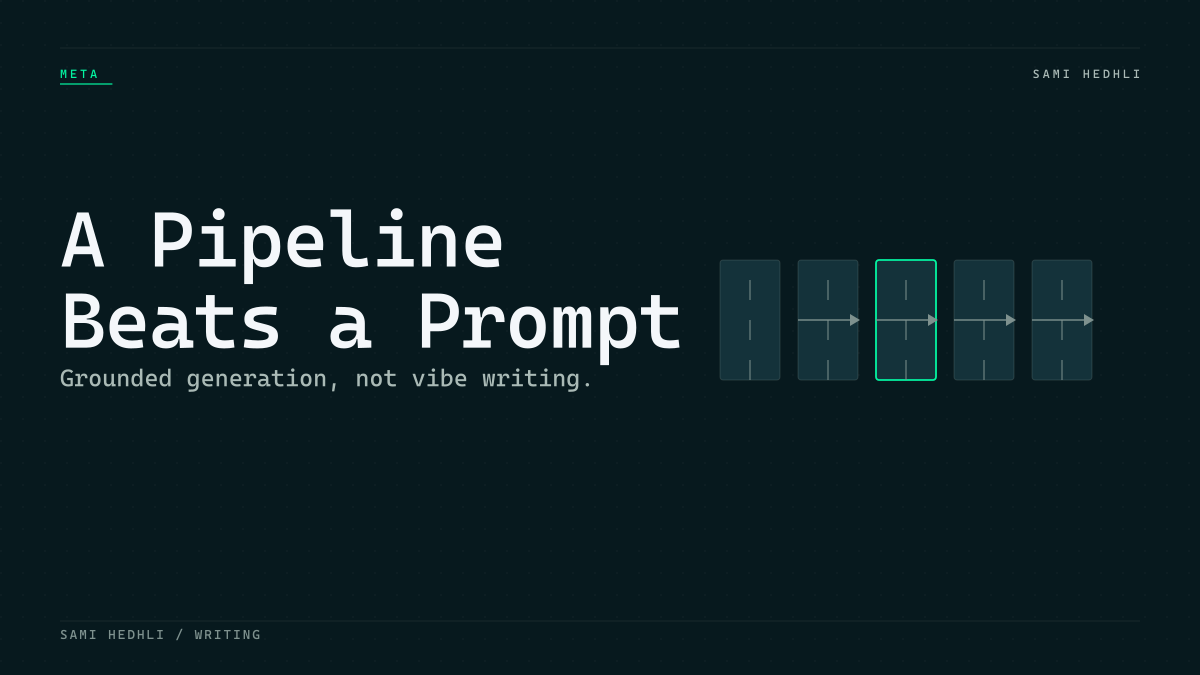
My generation flow follows a strict linear progression. The research stage gathers verifiable facts from targeted external queries. The outline stage builds a structural skeleton before a single prose sentence exists. The draft stage fills that skeleton following a rigid JSON schema. The critique stage flags unsupported claims. The repair stage fixes those flagged issues. This pipeline pattern makes the output reliable.
Separating structural planning from prose writing prevents the model from losing focus. When an LLM handles outline creation, source integration, and sentence composition simultaneously, it prioritizes plausible phrasing over structural discipline. Splitting these responsibilities into distinct execution stages keeps the context window focused on one isolated objective at a time.[3]
Critique and Repair Loops for Verifiable Drafting
Drafting raw prose without an automated review step invites silent factual drift. To prevent this, my pipeline runs a dedicated critique stage over the generated schema. The critique prompt acts as an adversarial evaluator. It searches every paragraph for unsupported claims, missing source citations, or vague hand-waving.
Automated evaluation data allows the system to identify missing evidence and improve drafts programmatically before human review. The critique stage generates a structured list of specific defects. If an assertion lacks a corresponding source identifier, the repair stage receives both the draft and the defect list, running a targeted patch pass.[4]
This self-correction pass catches roughly 80% of quality issues automatically. It eliminates generic filler phrases, aligns claims with source notes, and formats technical lists into readable prose. The repair stage does not rewrite the whole article from scratch. It updates only the specific paragraphs flagged during the critique pass.
Taming Edge Model Quirks and Payload Sanitization
Deploying model inference within Cloudflare Workers revealed real production quirks that generic tutorials omit. The GLM-4.7-flash model on Cloudflare Workers AI returns an OpenAI-compatible payload format under choices[0].message.content, rather than the legacy Workers AI format under result.response. The official documentation did not clarify this distinction. I discovered it by printing raw payload dumps.[1]
The model also wraps JSON responses in markdown code fences inconsistently. When code expects a raw JSON string, an unannounced triple backtick block breaks JSON.parse immediately. Every model response must pass through a strict sanitization layer before parsing.
export function stripCodeFences(raw: string): string {
  const trimmed = raw.trim();
  if (trimmed.startsWith('```')) {
    return trimmed.replace(/^```(?:json)?\s*\n?/, '').replace(/\n?```$/, '').trim();
  }
  return trimmed;
}
Defensive parsing is mandatory when orchestrating third-party models. You must treat every LLM output as untrusted external user input. Validate schemas, strip unexpected wrappers, and establish fallback error handling at every network boundary.[5]
Preventing Archive Overlap With Deduplication Gates
Topic duplication was a sleeper problem in my early automation experiments. Without a historical check, an AI pipeline will happily draft articles on topics you have already covered extensively. You end up repeating yourself, cannibalizing your search ranking, and diluting your content catalog.
I solved this by introducing a similarity gate before the research stage starts. The pipeline fetches existing post summaries from Sanity using GROQ queries. It builds a term frequency matrix and calculates cosine similarity between the proposed topic and published posts. When the similarity score exceeds 0.4, the pipeline flags the collision and pauses execution.[1]
This deduplication check operates like a retrieval validation query in reverse. Before you generate new text, you query your existing knowledge base to determine what ground you already own. Knowing your historical coverage prevents wasted computation and protects your site from redundant, thin content.[4]
The Human Gate Pattern: Automate the Grind, Gate the Publish
My most significant architectural decision was placing a mandatory human gate between draft generation and live publication. The pipeline compiles the final schema, writes the document directly to Sanity with a draft status, and triggers an email alert. Nothing ever auto-publishes to production.
Automated critique handles structural consistency, citation verification, and basic fact checking. However, the final 20% of quality requires human taste. An algorithm cannot evaluate narrative flow, comedic timing, personal perspective, or whether an article offers genuine insight to experienced developers. Automating the heavy research and drafting work frees your energy for high-level editorial decisions.[6]
A reliable system removes repetitive labor without relinquishing editorial control. When you remove the pressure to auto-publish, you can experiment aggressively with generation pipelines. A weak draft costs nothing to revise or delete in Sanity. Gating the final step preserves your brand integrity.[5]
Next Steps for Implementing Your Content Pipeline
Follow this concrete implementation plan to build a grounded, reliable content system for your own technical publication.
- Define a strict JSON schema for your content output, including sections, headings, and paragraph support arrays.
- Implement an initial deduplication gate using cosine similarity against your published CMS posts.
- Connect a real-time web search or note retrieval step to collect verified sources before drafting begins.
- Split generation into separate outline, draft, critique, and repair steps rather than running a single monolithic prompt.
- Add a robust payload sanitization utility to strip markdown fences and parse model responses defensively.
- Route completed drafts to your CMS with a draft flag and require manual approval before publishing live HTML.[3][5]
Sources
- Build a blog using Nuxt.js and Sanity.io on Cloudflare Pages · Cloudflare Pages docs
- How to Build a Generative AI-Enabled Synthetic Data Pipeline for Perception-Based Physical AI | NVIDIA Technical Blog
- How to build an AI content pipeline that actually works | eesel AI
- From Prompt to Production: Smarter AI with Evaluations
- Cloudflare Embeds AI in Real Engineering Workflow | Nebulai posted on the topic | LinkedIn
- AI Content Pipeline Software for Modern Inbound Engineering
Related articles
A Git Tree Is Enough: Running a Public Benchmark Without a Database
Ditch the server-side database. Use a structured folder tree in Git as your source of truth and build a manifest for a static SPA.
I Built an Open Benchmark for AI Frontend Generation
I replaced marketing-driven AI leaderboards with a verifiable, rendered benchmark that forces models to ship functional frontend code.
Automating Astro Rebuilds via Sanity Webhooks
Link your Sanity CMS content changes directly to Cloudflare Pages deploy hooks to automate your Astro site rebuilds without manual git pushes.